
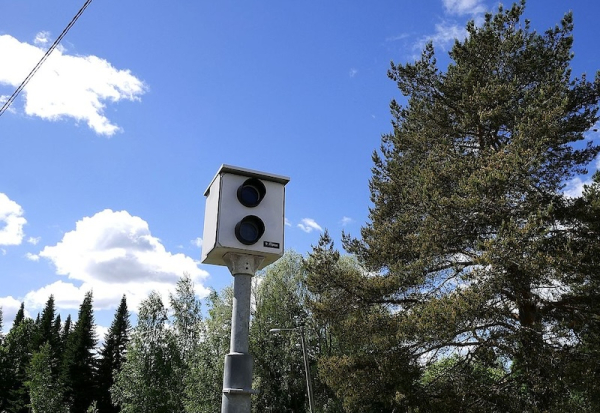

Speed camera on the side of a road. Photo: Santeri Viinamäki
- Next Article President Zelensky to visit Finland for talks on war and support
Traffic enforcement cameras across Finland are increasingly inactive as police struggle to process speeding violations, despite new and expensive equipment being installed on roads. The number of fines issued through automatic traffic monitoring has dropped significantly in recent years, leaving many cameras empty or fitted with decoy units.
According to police statistics, automated speed enforcement captured over 500,000 violations in 2019. By 2024, this figure had fallen to just 137,000.
The decline is widespread, with some regions seeing a reduction of up to 89 percent. In Espoo, the number of violations recorded by cameras has plummeted by 99 percent since the start of the decade.
Finland has around 1,100 speed cameras, but only a fraction are operational at any given time. There are approximately 900 older grey box-style cameras, with just 160 active units among them. Of the 200 newer, slim-design cameras installed in recent years, only about 120 contain functioning equipment.
The main issue is not the cameras themselves but the capacity of the police to process violations. Police Inspector Tuomo Katajisto from the National Police Board said that many cameras remain switched off to prevent overwhelming case backlogs.
“We could take many more photos of speeding drivers than we currently do. But if we keep all cameras active, cases would pile up and expire before we could process them,” Katajisto explained.
A legislative change in 2020 has made handling speeding fines more time-consuming. Minor speeding offences, previously subject to fixed fines, now require individual processing, increasing the administrative burden on police. Identifying the driver responsible for each offence has also become more complicated, further slowing down enforcement.
In addition to staffing shortages, Finland’s automatic traffic enforcement system has faced technical setbacks. The 2020 overhaul of the country’s road traffic law required a new digital system for processing violations, but the transition was not seamless.
Complicating matters further, the gradual shutdown of Finland’s 3G network disrupted older speed cameras, which relied on it to transmit data. New routers were required nationwide to restore functionality, but sourcing the necessary equipment caused further delays.
By mid-2024, police had received 95 new routers, allowing them to restore connectivity to older cameras. However, police say enforcement is still constrained by human re
Source: www.helsinkitimes.fi
